
Four-door hinged wardrobe — how to allocate space for clothes, bedding and seasonal items?
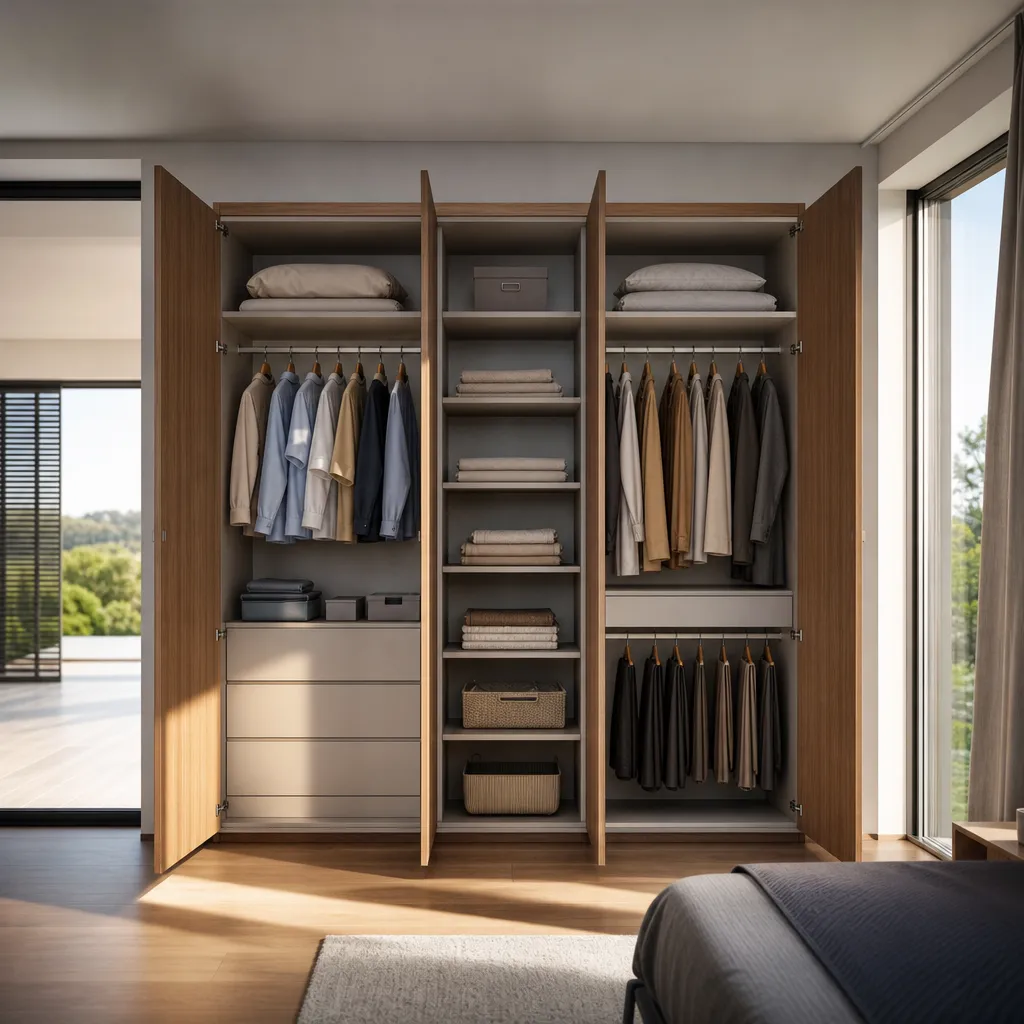
A four-door hinged wardrobe works best when you divide its interior into three zones from the start: everyday clothes, household textiles and occasionally used items. This is not a piece of furniture that “organizes itself” — comfort depends on the proportions between rails, shelves, drawers and top compartments. If you plan the interior well, one four-door wardrobe can replace an extra chest of drawers, part of an overhead storage space, and sometimes even a small walk-in closet. The most common mistake is buying a capacious wardrobe without checking what exactly needs to fit in it and how much space is required for doors to open freely.
The most important rule: divide the wardrobe into zones by frequency of use
If you are wondering how to allocate space in a four-door hinged wardrobe for clothes, bedding and seasonal items, start with a simple division:
- everyday zone — at hand and eye level,
- reserve zone — slightly higher or lower, but still conveniently accessible,
- seasonal zone — at the top and in the deepest parts of the wardrobe.
This solution works both in the bedroom and in the hallway, dressing room or a small apartment where one larger wardrobe has to take on several functions at once. In practice it means that shirts, trousers, T-shirts and underwear should not compete for space with duvets, suitcases and winter coats. When everything is put “where it fits”, the wardrobe becomes capacious only on paper.
What interior layout of a four-door wardrobe is most practical?
For a four-door wardrobe the most convenient layout is mixed: two sections with rails and two sections with shelves or shelf-and-drawer combinations. Such a division provides flexibility and allows you to store both hanging clothes and folded textiles.
Layout that works in most homes
- one part with a long rail for dresses, coats, long jackets or shirts,
- one part with a double rail for shorter items: shirts, blouses, trousers on hangers,
- one part with shelves for sweaters, T-shirts, jeans and household textiles,
- one part with drawers and a top compartment for underwear, accessories, bedding and seasonal items.
With a total width of about 180–220 cm such a layout usually gives the best balance between capacity and convenience. If the wardrobe is less than 180 cm wide, it is worth limiting the number of vertical divisions, because sections that are too narrow make using the interior difficult.
When more shelves, and when more rails?
Choose more rails if you wear many shirts, jackets, dresses, office clothes and items that wrinkle easily. Choose more shelves when most of the wardrobe consists of knits, T-shirts, sweatshirts, bedding and towels. For a couple an asymmetrical layout usually works best: one side more for hanging, the other more for shelving.
Which interior wardrobe dimensions really matter?
When buying a ready-made wardrobe or designing the interior, knowing the overall width of the furniture is not enough. The functionality is determined by the usable dimensions of individual zones.
| Element | Recommendation | For whom | What to watch out for |
|---|---|---|---|
| Wardrobe depth | 55–65 cm | For clothes on standard hangers | At 50 cm or less clothes may crease and protrude |
| Height of rail for long garments | 150–170 cm | Dresses, coats, long cardigans | Clothes hung too low will rest on the bottom |
| Double rail | 2 x 90–105 cm usable height | Shirts, jackets, trousers folded in half | Not suitable for coats and long dresses |
| Shelves for folded garments | Width 40–60 cm, height 30–40 cm | Sweaters, jeans, T-shirts | Too wide shelves bend and create chaos in stacks |
| Bedding shelf | Height 35–45 cm | Bedding sets, blankets, bedspreads | Too low space makes it difficult to remove larger textiles |
| Top seasonal storage | 40–60 cm height | Suitcases, boxes, out-of-season clothes | Without organizers items quickly mix together |
In practice, about 60 cm depth is the safest. A shallower hinged wardrobe can be tempting in a small flat, but it reduces daily comfort more than it seems at purchase.
How to allocate space for everyday clothes?
Everyday clothes should occupy the most accessible sections. These determine whether the wardrobe will be convenient in the morning when you are in a hurry, or become a source of frustration. A good rule is: what you reach for several times a week should be neither too high nor too low.
Practical division for one person
- a rail for shirts, blazers, dresses or trousers on hangers,
- 2–4 shelves for T-shirts, sweaters and jeans,
- 1–2 drawers for underwear, socks and accessories,
- a separate small zone for belts, scarves, bags or hats.
Practical division for a couple
It is best not to divide the wardrobe exactly “in half”, but according to real needs. One person may need a 90 cm rail and 3 shelves, the other a 60 cm rail and 6 shelves. This is especially important in bedrooms where a four-door wardrobe is meant to replace two separate pieces of furniture.
A good approach is to dedicate the central sections to daily wear and the outer ones to less used items. That way you open the same doors most often and “scatter” the wardrobe contents less.
Where to store bedding, towels and household textiles?
Bedding and household textiles are best stored in the shelving part, not on rails or loose at the bottom of the wardrobe. Contrary to appearances they need not only space but also sensible shelf heights. Overpacked bedding quickly becomes messy, and taking out one set ends up disturbing the whole stack.
The best zone for bedding
- middle or upper shelves with a height of 35–45 cm,
- textile baskets or containers labelled: “bedding”, “blankets”, “guest towels”,
- sets stored in a pillowcase — easier to keep tidy,
- less frequently used items higher up, daily items lower.
If there is no separate utility closet at home, it is worth planning space in one of the sections for spare pillows, a lightweight blanket or mattress protectors. In small flats such multifunctionality is usually necessary, but it requires discipline: household textiles should be kept separate from clothing immediately.
How to store seasonal items so they don’t take up everyday space?
Seasonal items should go into upper compartments, rear parts of shelves and closed organizers. It’s not only about saving space, but also about protecting clothes from dust, moisture and creases.
What belongs to the seasonal zone?
- winter coats and snowsuits in summer,
- summer dresses and linen clothes in winter,
- blankets, duvets of different weights,
- suitcases, travel bags, holiday accessories,
- sports equipment used only for part of the year.
How to organize it practically?
- use boxes or bags with a description of the contents,
- place heavier items lower than lighter ones, even in the seasonal zone,
- wash or clean clothes that will be stored for several months before putting them away,
- avoid storing everything in non-ventilated plastic bags for a long time.
If the wardrobe stands in the bedroom, seasonal items should not occupy the central part of the interior. This is a common mistake: large boxes and duvets end up where they are easiest to put, pushing the everyday wardrobe into inconvenient, random places.
How much space is needed in front of a four-door hinged wardrobe?
A wardrobe with hinged doors requires more free space in front of the front than a sliding model, but provides more convenient access to the entire interior at once. This is important especially when you want to clearly divide zones and browse them quickly.
Practical distances
- minimum 80–90 cm in front of the wardrobe — the absolute minimum to open and stand,
- 100–120 cm — comfortable space to use drawers and browse clothes,
- if a bed is opposite, leave preferably at least 90 cm of passage, and comfortably about 110 cm.
In a small bedroom, check whether the front wings do not hit a bedside table, chest of drawers or radiator when opened. Hinged doors are very practical, but only if they can really be opened wide. Otherwise part of the shelves and drawers will be accessible only “halfway”.
Ready-made wardrobe or custom — what to choose with four doors?
Not every four-door hinged wardrobe has to be made to measure. A ready-made model is sufficient if you have a simple wall, standard room height and typical storage needs. A custom wardrobe makes sense when you want to use a recess, a slant, a very high ceiling or need an unusual interior layout.
When is a ready-made wardrobe enough?
- when a width of 180–220 cm fits well on the wall,
- when a height of about 200–240 cm is sufficient,
- when you don’t need a non-standard number of drawers or very specific zones,
- when you care about a better price and faster delivery.
When is it justified to pay extra for a custom wardrobe?
- when every centimeter counts in a small apartment,
- when you want built-in units to the ceiling without wasting space above the furniture,
- when you need more containers, a pantograph, pull-out baskets or special dividers,
- when the wardrobe must combine the function of clothing storage, a lingerie drawer and a seasonal storage in one block.
It is worth remembering that even a good ready-made wardrobe can gain a lot from simple upgrades: additional shelves, organizers, containers and dividers for drawers.
Most common mistakes when planning the interior of a four-door wardrobe
Most problems do not result from the quality of the piece itself, but from incorrect interior planning. Here are the mistakes that most often pay off after a few weeks of use:
- too many shelves, too few rails — hanging clothes then end up on chairs and wall hooks,
- one huge compartment without division — theoretically capacious, practically unusable,
- storing bedding with everyday clothes without a separate section,
- no seasonal zone, causing winter and summer items to mix all year round,
- shallow wardrobe bought just to save a few centimetres in the room,
- ignoring door opening space,
- not checking delivery access — especially in apartment blocks with a narrow stairwell, small lift and sharp turns,
- buying for the look of the fronts, not for the actual contents.
Before buying, make a simple list: how many long garments you have, how many folded items, how many sets of bedding, how many seasonal jackets and whether you also want to store suitcases there. This gives a better answer than manufacturer descriptions like “very spacious”.
How to match a wardrobe to the interior style without losing functionality?
In the bedroom and hallway a wardrobe occupies a large visual area, so its colour and shape matter. At the same time it is not worth choosing fronts solely because of fashion. A four-door hinged wardrobe should match the room, but above all not overwhelm it by scale.
What works most often?
- light fronts — good for small bedrooms and flats, they visually calm the mass,
- wood or wood-effect decor — warms the interior and easily matches a bed, chest of drawers or bedside tables,
- matte finish — usually more practical than high gloss, because fingerprints are less visible,
- mirror on one or two fronts — useful in the bedroom and hallway, but best used sparingly.
In Scandinavian, japandi or modern styles, simple fronts without excessive divisions look good. In classic interiors you can opt for subtle milling, but it is still worth ensuring the construction does not look visually heavy. If the room is low or tight, a floor-to-ceiling wardrobe in a colour close to the wall often appears lighter than a dark, contrasting piece ending 20–30 cm below the ceiling.
FAQ — most common questions about the four-door hinged wardrobe
Is a four-door hinged wardrobe suitable for a small bedroom?
Yes, provided you leave enough space for the doors to open. In a small bedroom a taller rather than wider model works better, with good use of the top area for seasonal items.
What depth is best for a hinged wardrobe?
The most practical depth is about 60 cm. It allows you to hang clothes on standard hangers comfortably and reduces garment creasing.
How many shelves should a four-door wardrobe have?
Usually 6–10 shelves of varying heights work well, but the number should depend on the contents. Too many shelves can be as inconvenient as too few because they limit hanging space.
Where should bedding be stored in the wardrobe?
Preferably on separate shelves with greater height, usually 35–45 cm. It helps if this is a section separated from everyday clothes to keep things tidy more easily.
Can seasonal items be stored on top of the wardrobe?
Yes, it is one of the best places. Use labelled boxes or organisers so the contents are protected and easy to find.
What is better: one wide section with a rail or two smaller ones?
In most cases two smaller ones are better because they offer more flexibility. You can combine a long rail with a double arrangement for shorter garments.
Can a four-door wardrobe replace a chest of drawers?
It can, if it has at least 2–4 drawers or a well-planned shelving section. Without dedicated zones for small items a chest of drawers is often still needed.
What to pay attention to when buying a wardrobe online?
Check not only the external dimensions but also the internal layout, usable depth, number of shelves, type of hinges, package weight and the possibility of bringing the furniture into the flat. Front photos won’t tell you if the wardrobe will be convenient in daily use.
Is it worth choosing a wardrobe with a mirror?
Yes, if you need to visually brighten the interior and have a place to check your appearance without buying a separate mirror. Bear in mind that smudges and fingerprints are more visible on mirrors and glossy surfaces.
How often should you reorganise the inside of the wardrobe?
At least twice a year, when the season changes. This is the best time to move seasonal clothes to the top sections and restore quick access to everyday items.