
How to care for the tracks and rollers in a sliding wardrobe?
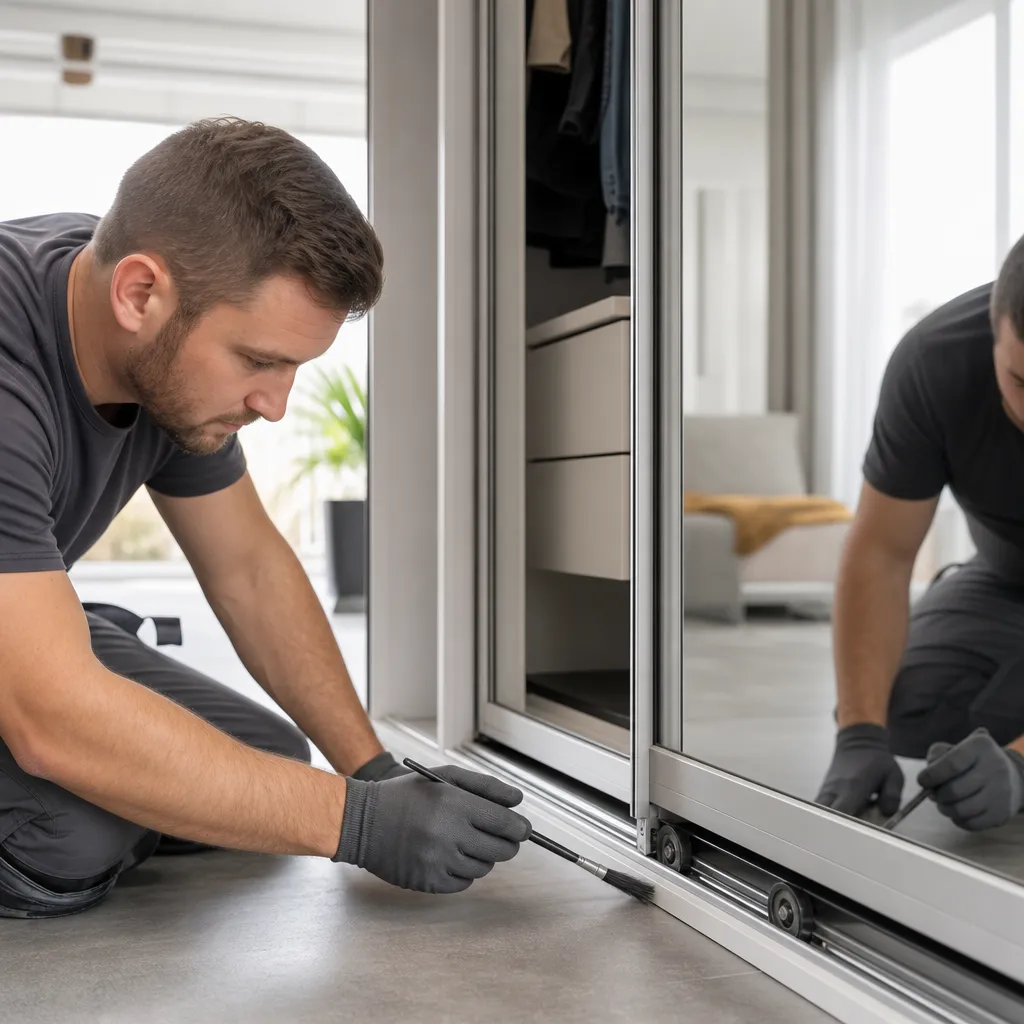
Tracks and rollers in a sliding wardrobe should be cleaned regularly, but not excessively and without random lubricants. The most important rule is: first remove dust, sand and hair from the running tracks, and only then assess whether the mechanism requires adjustment or gentle lubrication. In practice most problems with stiff doors do not result from a “worn wardrobe”, but from neglected tracks, poorly adjusted panels or an overloaded interior. This is a topic of cleaning and maintenance, but it is also closely related to the furniture construction, the quality of the fittings and everyday functionality.
The most important answer: you maintain tracks and rollers by regular cleaning, checking door alignment and careful lubrication only when the manufacturer allows it
If you want a sliding wardrobe to operate quietly and smoothly for years, do not wait until the doors start to jerk, fall off the track or make noise. A good practice is a short inspection every 1–2 months and a more thorough cleaning every 3–6 months, and in an entrance hall or a home with pets even more often. In such interiors particles of sand, fur, dust and moisture from shoes reach the tracks faster, and these are what wear rollers out most quickly.
It is worth remembering that not only the bottom or top track works in sliding wardrobes. The following also matter:
- running rollers,
- guides,
- stoppers and limiters,
- baffle brushes,
- vertical adjustment of panels,
- stability of the wardrobe carcass and floor evenness.
Therefore maintenance does not consist solely of “spraying something slippery” into the rail. Often it is precisely the excess of a random product that collects dirt and after a few weeks worsens the system’s operation.
What most often spoils the operation of sliding wardrobe doors
In everyday use problems usually start inconspicuously. The doors put up slight resistance, a metallic sound appears, a panel begins to rub slightly against the side of the wardrobe or does not close perfectly to the end. This is a signal that it is worth reacting quickly before the rollers, track or panel wear out unevenly.
Most common causes of problems
- Dust and sand in the track – especially in the entrance hall and the cloakroom near the entrance.
- Fur and hair – wrap around roller axles and hinder rotation.
- Random lubricants – e.g. thick technical oil that binds dirt.
- Misalignment of panels – doors begin to rub against the track or sides.
- Overloading the wardrobe – especially with poorly designed interiors and heavy fronts.
- Uneven floor or carcass deformation – typical for large ceiling-height wardrobes.
- Worn rollers – after years of use the plastic may crack or flatten.
If the wardrobe stands in a small apartment where it combines the functions of a wardrobe, storage cupboard and seasonal storage, the mechanism is usually loaded more than in a light bedroom wardrobe. This is important especially for ready-made models from mass retailers, where fittings can be adequate but not as durable as in better bespoke furniture systems.
How to clean the tracks in a sliding wardrobe step by step
The safest method is simple and does not require specialized tools. Accuracy matters more than force.
Step 1: clear the work area and assess the problem
You don’t need to empty the whole wardrobe, but it’s worth removing items that may obstruct access to the lower track. Open the panels and check whether resistance occurs along the entire length of the track or only in one spot. If only local, dirt or damage to the track is likely to blame.
Step 2: vacuum the track
Use the crevice tool on a vacuum cleaner. First vacuum the lower track, then the upper, and finally the areas around the rollers. This is important because wiping with a damp cloth without prior vacuuming may only smear particles and push them deeper.
Step 3: remove stuck-on dirt
For accumulated deposits, use a soft brush, cotton swabs, or a slightly damp microfiber cloth. If the track is aluminium, usually water with a little mild detergent is sufficient. After cleaning, be sure to dry the track.
Step 4: check the rollers and guides
Look for hairs, threads and fur on the axles. If visible, remove them carefully with tweezers. If a roller does not rotate smoothly despite being clean, it may need adjustment or may already be worn.
Step 5: test the door movement
After cleaning, slide each panel several times through its full range. If the doors run quieter and lighter, the problem was most likely solved. If they still rub, jump or tilt out of plumb, proceed to adjustment.
Should you lubricate rollers and tracks? Yes, but not always and not for everything
This is one of the most common user mistakes. Many people assume that if something moves with difficulty, it must be lubricated. However, in some modern systems the bearing material and mechanism design are chosen to operate almost “dry” or only with minimal support from a suitable product.
When lubrication makes sense
- when the system manufacturer explicitly allows it,
- when, after thorough cleaning, friction is still audible,
- when the mechanism is not damaged but runs too dry,
- when you use a product intended for furniture fittings or a light silicone lubricant in a small amount.
What not to use
- heavy machine oils,
- automotive greases,
- random “do-it-all” products,
- a large amount of WD-40 as a permanent maintenance agent.
Note: penetrating agents can temporarily help loosen a seized element, but are not always a good solution for long-term care of wardrobe rollers. They often leave a residue that attracts dust more quickly.
| Element | Recommendation | For whom | What to watch out for |
|---|---|---|---|
| Lower track | Vacuum every 2–4 weeks, wipe with a slightly damp cloth every 2–3 months | Hallway, wardrobe, homes with pets | Do not leave moisture and do not rub dirt without prior vacuuming |
| Upper track | Remove dust with a brush or vacuum every 1–2 months | Large floor-to-ceiling wardrobes and built-in alcove units | Do not ignore dust that over time falls onto rollers and stops |
| Running rollers | Check for hairs, threads and rotation smoothness every 3–6 months | Any frequently used wardrobe | Do not lubricate without checking manufacturer recommendations |
| Door adjustment | Check plumb, gaps and closing at the first signs of rubbing | Tall wardrobes, heavy fronts, custom furniture | Too large a correction at once can worsen panel alignment |
| Maintenance products | Only light products, in minimal amount and after cleaning | Users of older systems with noticeable friction | Excess product attracts dust and may accelerate wear |
How to tell that a wardrobe needs adjustment, not just cleaning
Not every problem will be solved by a vacuum cleaner. If the sliding doors are misaligned, even clean tracks will not ensure smooth operation.
Signs of misalignment
- a panel is crooked relative to the side of the wardrobe,
- the gap at the top is different than at the bottom,
- the doors slide open by themselves or do not close,
- one panel rubs against the other,
- the front scrapes along the track despite clean rollers,
- a knock or jump is heard at the end of the movement.
In many systems you can gently correct the height of the rollers with an adjustment screw. However, if you do not have the manufacturer’s instructions or access to the fittings is difficult, it is better to act cautiously. Poorly performed adjustment may cause the doors to fall off the track or crack the fastening elements.
In made-to-measure wardrobes with mirrored fronts or heavy panels 90–120 cm wide, it is worth treating adjustment as technical servicing rather than a DIY experiment. The weight of the panel is large, and damage to the mirror or frame can be costly.
How to care for a sliding wardrobe depending on the room
The same solution works differently in a bedroom, differently in an entrance hall, and yet differently in a small apartment where the wardrobe is used dozens of times a day.
Entrance hall
This is the most demanding environment for tracks. Sand, mud, road salt, pet hair and lint from clothes get into the tracks. In such a place it is worth vacuuming the track every 1–2 weeks. If the wardrobe is located close to the entrance door, a doormat that effectively traps debris from footwear is a good idea.
Bedroom
Here the problem is more often textile dust, hair and lint from bedding. The wardrobe usually wears out more slowly, but if it has large mirrors, you should regularly check whether the doors are operating with resistance. Any sudden movement transmits vibrations to the glass.
Walk-in closet
In a walk-in closet the intensity of use can be very high, especially if it is used by two or more people. When the interior is overloaded, clothes can stick out and block the closure of the panels. This stresses the rollers more than everyday sliding itself.
Small apartment
In a studio and compact apartment a sliding wardrobe often serves several functions at once: storing clothes, household equipment, suitcases and seasonal textiles. It is therefore worth paying attention not only to the fittings themselves but also to the interior ergonomics. Well-designed shelves and rails reduce door overload and prevent accidental catching on the fronts.
The most common mistakes that shorten the life of rollers and tracks
In practice, users rarely destroy the mechanism with one big mistake. More often the problem is caused by a sum of small neglects.
- Failing to vacuum the track regularly – dust acts like an abrasive paste.
- Lubricating a dirty track – creates a sticky residue.
- Forcing the doors to slide – when something blocks the movement, first find the cause.
- Leaning on the panels – particularly dangerous with mirrored fronts.
- Slamming the doors – destroys stoppers and misaligns the mechanism.
- Ignoring the first signs of noise – a small problem is quicker and cheaper to fix.
- Attempting to disassemble heavy panels without securing them – risk of damaging the front and injury.
If you are buying a new wardrobe, pay attention to the quality of the fittings already at the stage of choosing the furniture. For ready-made furniture it is worth asking about the roller material, adjustment options, availability of spare parts and the maximum panel load. This is more practical information than the appearance of the fronts alone.
When home maintenance is enough and when parts need replacing
Not every malfunction means you need to buy a new wardrobe. Often it is enough to clean the track, correct the door alignment, or replace the rollers. This is especially worthwhile for made-to-measure wardrobes and large built-in alcove units where the carcass is still in good condition.
Signs that maintenance is enough
- the doors operate more stiffly, but without jumping,
- the problem appeared suddenly after a period without cleaning,
- dirt is visible in the track,
- the roller turns but with resistance,
- the doors are slightly misaligned.
Signs that rollers may need replacing or servicing
- the roller is cracked or flattened,
- the front clearly sags despite adjustment,
- the doors come off the track,
- the guide is bent or mechanically damaged,
- you hear metal-on-metal or metal-on-board grinding,
- the system does not stay vertical despite correction of the setting.
In older wardrobes it is worth first checking whether the manufacturer or carpenter still offers compatible parts. Sometimes replacing a set of rollers for a few dozen or a few hundred of the local currency can extend the life of the installation by many years.
FAQ: most common questions about guides and rollers in a sliding wardrobe
How often should guides in a sliding wardrobe be cleaned?
In the bedroom it is usually enough every 1–2 months, more precisely every 3–6 months. In the hallway, with children or pets, it is better to check the track every 2–4 weeks.
Can the guides be vacuumed with a regular vacuum cleaner?
Yes, preferably with a crevice tool and at moderate power. This is the simplest and safest method for removing sand, dust and hair.
Is WD-40 suitable for rollers in a sliding wardrobe?
It can help temporarily with a seized element, but it should not be the default agent for regular maintenance. It is better to use products recommended by the system manufacturer.
Why do sliding wardrobe doors make noise despite clean guides?
The cause may be misaligned wings, a worn roller, a damaged stopper or uneven carcass alignment. Cleaning alone will not solve the problem then.
Can sliding doors be adjusted by oneself?
Often yes, but only if you have access to the adjustment screw and know how the specific system works. For large, heavy or mirrored fronts it is safer to entrust this to a professional.
What to do when a roller jumps on the guide?
First thoroughly clean the track and check whether there are dents or foreign bodies in it. If the problem returns, roller wear or incorrect door height adjustment is possible.
Does the lack of a lower guide mean fewer problems?
Not always. Suspended systems look lighter and it is easier to keep the floor clean, but they require a solid structure and high-quality fittings. Each solution has different maintenance requirements.
How to care for a sliding wardrobe if there are cats or dogs at home?
You need to remove hair from the lower track more often and check the roller axles. Pet hair easily winds onto running elements and worsens sliding smoothness.
When does replacing the entire wardrobe make more sense than repairing the mechanism?
When not only the sliding system is damaged but also the carcass, the boards are swollen from moisture, and spare parts are unavailable. In a good made-to-measure installation repair is usually more cost-effective than replacing the whole.
Do heavy mirrored fronts wear out rollers faster?
Yes, because greater mass places more load on the mechanism. Therefore, in such wardrobes the quality of rollers, proper installation and regular inspection are even more important.