
Sliding doors without a floor track — how does the panel guidance work?
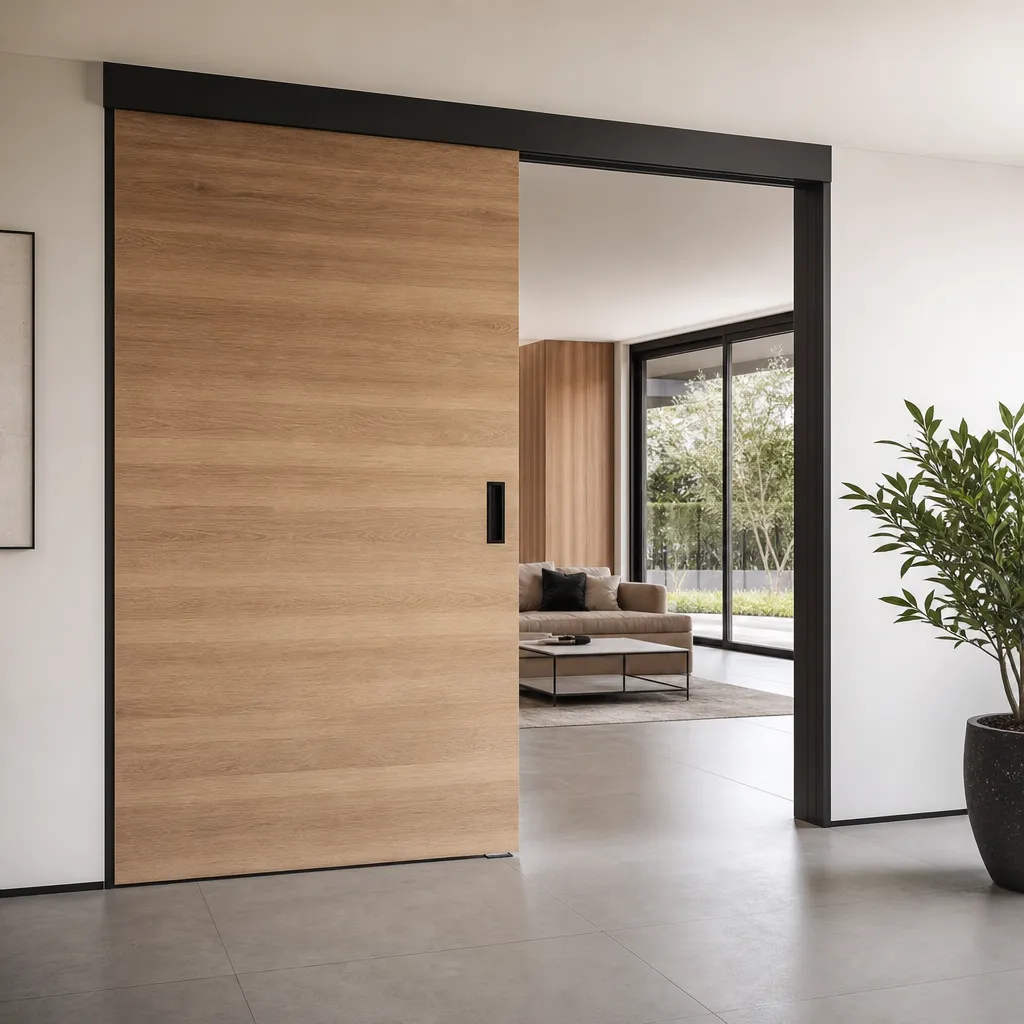
Sliding doors without a floor track operate stably when the weight of the panel is taken by the top system, and the bottom only guides the door and prevents it from tilting. This solution is chosen by people who want to avoid a threshold, make cleaning easier and keep a smooth floor in the living room, bedroom, wardrobe or a small apartment. However, one thing is crucial: no floor track does not mean no bottom guidance. If this detail is chosen poorly, the doors may make noise, wobble or rub against the surround.
In practice, the topic mainly concerns construction, functionality and custom-made furniture, because the way the panel is guided affects both the convenience of daily use and the cost-effectiveness of the entire installation. That is why it is worth understanding how the system works, how much space it needs and when it really makes sense before purchasing.
The most important answer: doors without a floor track have bottom guidance, but not in the form of a rail
Simply put, in sliding doors without a floor track the load is transferred by the top profile with rollers, and the bottom part of the panel is stabilised by a small guiding element. Most often this is:
- a pin guide mounted to the floor,
- a guide with a roller or a plastic slider,
- a groove in the bottom edge of the panel in which the guide operates,
- a hidden side stabiliser in some built-in systems.
Thanks to this, there is no classic rail underfoot, i.e. a long track visible on the floor. This is important in passages between the living room and the hallway, for wardrobes in the bedroom and where children, elderly people or owners of robot vacuum cleaners live. Visual and practical comfort is greater, but only if the wall, lintel or furniture carcass is sufficiently stable for the top system.
How does the panel guidance work in practice?
The top system carries the weight
Carriages with bearings or rollers operate in the top track. They carry the panel and are responsible for smooth sliding. The heavier the door, the more important the quality of the profile, the maximum load capacity of the system and the accuracy of installation.
In furniture and alcove installations, panels weighing from about 20 to 80 kg are common, and in heavier projects even more. Light fronts made of furniture board or MDF can be hung relatively easily, but wide panels with a mirror, glass, aluminium frame or full-height installation to the ceiling already require a well-calculated system.
The bottom stabilises the path of movement
There is no running rail at the bottom, but there is an element that keeps the panel aligned. Most often the doors have an invisible groove in the bottom edge, and a small guide is mounted in the floor or in the base of the carcass. When you slide the door, the panel “slides” along it and does not deflect sideways.
This solution has several advantages:
- it does not collect dust like a classic floor track,
- it does not create a threshold in the passage,
- it looks lighter and more modern,
- it makes it easier to combine with panels, boards and porcelain stoneware.
Soft-closing devices improve operation quality
Better systems use a soft close or end cushioning. It does not guide the panel, but it significantly affects comfort. The doors do not then strike the side of the installation and do not bounce back when closing. In small apartments, where the installation is used several times a day, this difference is noticeable from day one.
When do sliding doors without a floor track make sense?
This solution works best where a clean floor line and easy movement inside the room matter. However, it will not always be the best choice for every wardrobe or alcove.
- In a walk-in closet and bedroom – when you want to avoid dust collecting in a track and care about a calm, aesthetic look of the built-in furniture.
- In the hallway – if the passage is narrow and any protruding element on the floor is bothersome.
- In a small apartment – when easy cleaning and an uninterrupted floor appearance are important.
- In transitions between zones – e.g. living room–study, living room–dining room, where a floor track would be clearly visible.
- With custom-made furniture – because you can precisely match the width of the wings, grooves and mounting method.
This solution is less advantageous where the wall or ceiling is structurally weak and the wing is very heavy. Then a classic system with a bottom track may simply be safer and more resistant to installation errors.
Which is better: doors without a floor track or a classic track system?
| Element | Recommendation | For whom | What to watch out for |
|---|---|---|---|
| Doors without a floor track | Choose if you care about a smooth floor, aesthetics and easy cleaning | For bedrooms, walk-in closets, modern interiors, small apartments | Requires stable top mounting and a well-chosen bottom guide |
| System with a classic bottom track | Choose for heavy wings and where a simpler construction matters | For large sliding wardrobes, economical built-ins, heavily used fronts | The track collects dust, can be harder to clean and more visible |
| Soft-close mechanism | Worth paying extra for if the doors are used frequently | Families with children, built-ins in living areas, walk-in closets | Not every system allows later installation |
| Wing wider than approx. 100 cm | Use only with an appropriate system and a stiff wing construction | For large niches and premium built-ins | Too wide doors may wobble and operate less precisely |
| Ready-made furniture | Check the type of guidance carefully before purchase | For those looking for a cheaper solution | The term “without track” can be marketing — a bottom stabilizer is still required |
If appearance and user comfort matter, sliding doors without a floor track are usually better. If the priority is lower cost, very high resistance to overloads or massive wings, a classic system may be more practical.
What wing dimensions and proportions are safe?
For sliding doors, it is not enough to consider only the niche width. Height, filling weight, panel stiffness and the method of mounting the guidance also matter. This is especially important for floor-to-ceiling built-ins and custom wardrobes in hallways and bedrooms.
Practical ranges
- Width of a single wing: around 60–100 cm is often comfortable.
- Height: typically 200–260 cm, but with taller fronts you must monitor stiffness and hardware quality.
- Built-in depth: for a wardrobe with a rail usually minimum around 60 cm, and more comfortably 62–65 cm allowing for fronts and technical clearances.
- Clearance at the floor: depends on the system, but usually a few to a dozen millimetres.
Too narrow and very tall wings can function correctly but will look disproportionate. Conversely, very wide doors with a heavy mirror can appear luxurious, yet without a good system they will more quickly reveal installation weak points.
How much space should be left around the built-in?
For a wardrobe or walk-in closet, allow at least 80–90 cm of free passage in front of the fronts, and more comfortably about 100–120 cm. In a small bedroom this is important because sliding doors do not take space for opening like hinged ones, but the user still needs to stand in front of the built-in, pull out a drawer or remove a container.
What to pay attention to when buying ready-made furniture and custom-built units?
This is one of those topics where a nice photo in an online shop is not enough. You need to ask about the operating technique.
In ready-made furniture
- check whether the system is really top-hung,
- ask for information about how the bottom guide looks,
- see the maximum load of a single wing,
- make sure whether a soft-close is standard or comes at an extra cost,
- check the material of the fronts: board, MDF, aluminium frame, mirror, glass.
In custom-built units
Here it is worth paying extra when the niche is crooked, unusually tall, sloped or when you want to use the space up to the ceiling. A carpenter or manufacturer should assess whether the wall and ceiling structure allows for such a system, and select appropriate profiles and guides.
Custom furniture makes particular sense if:
- the niche has a non-standard width,
- you plan fronts up to the ceiling,
- you want to combine a wardrobe with a chest of drawers, a seat or a wall panel,
- you want to hide irregularities in the walls and floor,
- the interior storage needs to be planned precisely.
Common mistakes that make doors without a floor track work poorly
The idea itself is good, but execution can be problematic. Most faults do not result from the system itself, but from underestimating the details.
- A wing too heavy for a too-light system – the result is resistance, noise and faster wear of the rollers.
- Poor fastening of the top rail – particularly dangerous with plasterboard walls without appropriate reinforcements.
- Lack of a precise bottom guide – the doors wobble and hit the carcass.
- An uneven floor or a poorly levelled carcass – even a good system then starts to operate unevenly.
- Incorrectly chosen wing width – access to shelves and drawers turns out to be inconvenient.
- Skipping a soft-close in heavily used installations – over time noise and the risk of damage increase.
- Buying “blindly” online without checking the construction – marketing descriptions do not replace technical data.
If you order a wardrobe online, ask the seller for a technical drawing, the method of guiding the wing, the weight of the fronts and information whether the furniture stands perfectly on the floor or requires leveling. These are the little details that later decide about everyday comfort.
In which interiors do such doors work best?
Sliding doors without a floor track suit several types of arrangements particularly well. It is not only about style, but also about how the apartment is used.
Modern living room and open zones
In modern interiors, clean lines and reducing visible technical details matter. The absence of a floor track works well with large tiles, engineered wood flooring and minimalist media units, chests of drawers or custom modules.
Bedroom with a walk-in closet
Here you will especially appreciate easier cleaning. If there is little space by the bed, every convenient circulation matters. A wardrobe with such a system can look lighter than a classic sliding one with a pronounced bottom, especially when the fronts are the colour of the wall or with mirrors optically enlarging the interior.
Hallway and small apartment
In narrow circulation paths, a threshold or a floor track is most obstructive. This also applies to families with children, strollers and pet owners. A smooth floor is simply more practical. In studio apartments and flats of around 40–50 m² such a detail realistically affects the perception of the space.
How to care for sliding doors without a floor track?
Maintenance is simpler than with classic bottom tracks, but it should not be neglected. The lighter the system works, the longer it will retain smooth operation.
- regularly remove dust from the upper profile and around the guide,
- check whether sand has gotten into the groove in the bottom edge,
- do not soak the fittings with detergents or water,
- clean the front according to the material: differently for a mirror, differently for lacquer, differently for laminated board,
- periodically check the screws and the height adjustment of the panel.
If the system starts to make noise, do not use random lubricants without the manufacturer’s recommendations. Some products bind dust and worsen the rollers’ operation. First, it is worth cleaning the guidance and checking the adjustment.
FAQ
Are sliding doors without a floor track stable?
Yes, provided it is a quality top-hung system and a proper bottom guide is used. Instability usually results from incorrect installation or poorly chosen panel proportions.
Does the absence of a floor track mean the doors do not touch the floor at all?
No. Most often they have a small clearance, and their bottom edge works with a guide or stabilizer. There is no classic running track running along the floor, however.
For which wardrobe is such a system worth choosing?
Best for wardrobes in the bedroom, walk-in closet and hallway, especially where aesthetics, easy cleaning and comfortable passage matter. For very heavy, wide fronts, the system’s load capacity must be checked carefully.
Are doors without a floor track more expensive?
Usually yes, especially if better fittings, soft-closing devices and precise installation are included. The price difference often pays off in user convenience and a more refined appearance of the installation.
Are such doors suitable for a small apartment?
Yes, it is one of the better solutions for small interiors. The lack of a floor track improves passage comfort and makes the space appear visually calmer.
Can you buy a ready-made wardrobe with such a system?
Yes, but you must read the specification very carefully. Not every manufacturer clearly states whether the system is truly without a lower running track or only has a less visible track.
How to check if the wall is suitable for mounting a top-hung system?
A contractor or carpenter is best placed to assess this. The wall material, anchoring method, lintel load-bearing capacity and any reinforcements for drywall installations are important.
Will a robot vacuum cope better with doors without a floor track?
Usually yes, because there is no long track collecting dirt. You should only remember that a small lower guide may still be present, although it is usually less problematic than a classic track.
Can a mirror be used on such doors?
Yes, but a mirror increases the panel’s weight. Therefore, the system’s permissible load, the quality of the carriages and the rigidity of the entire front construction must be checked.