
What wardrobe depth is suitable for storing clothes on hangers?
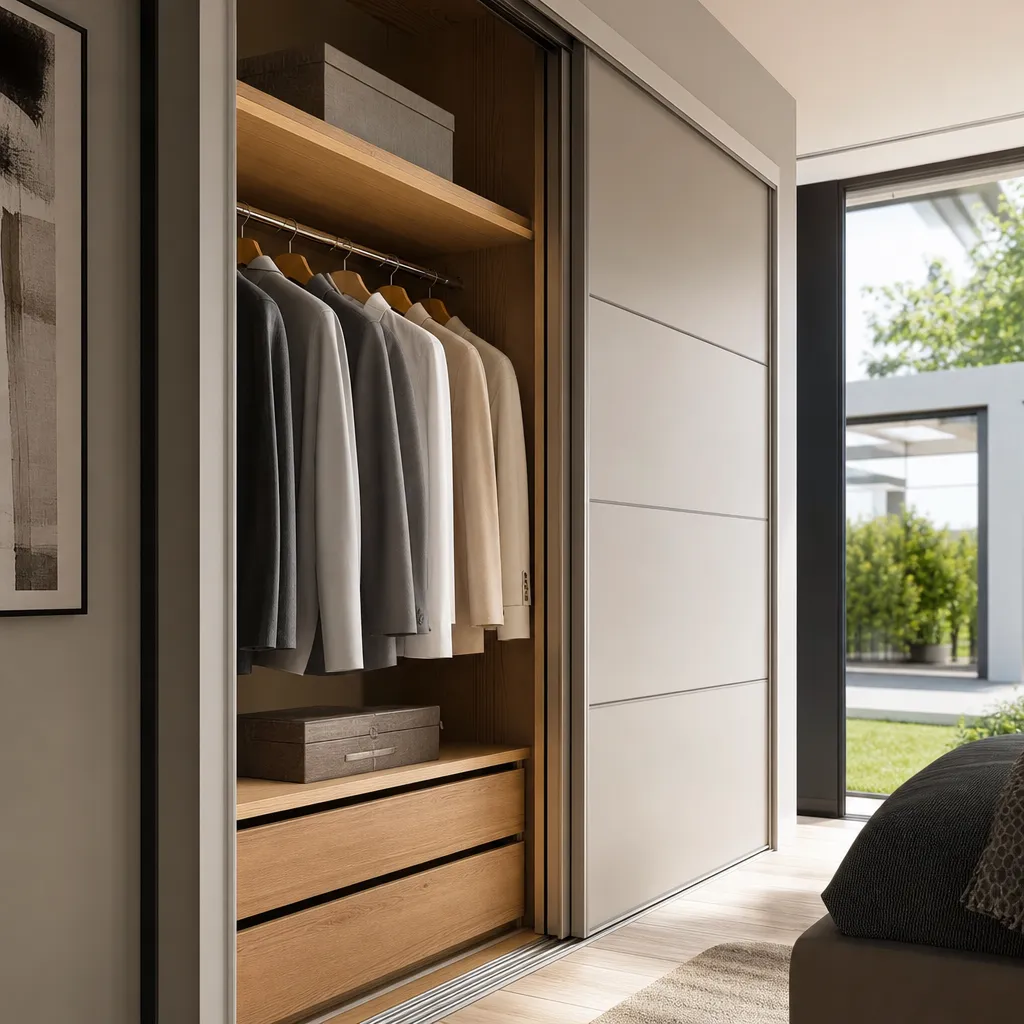
If a sliding wardrobe is to comfortably store clothes on hangers, the safest choice is a depth of 60 cm, and in practice it is best to aim for 62–65 cm external depth. This dimension usually allows standard hangers to fit freely, prevents sleeves from being crushed and avoids blocking sliding doors. A shallower wardrobe can be tempting in a small apartment, but this is where costly mistakes are most likely: the piece looks fine on the plan, but then jackets and coats have to be forced in at an angle.
In this matter, not only the number in the specification counts, but also the actual usable depth, the type of doors, the thickness of the fronts and the interior layout. Therefore, before purchasing it is worth checking how much space will actually remain for hangers and whether the wardrobe must accommodate shirts, jackets, long coats, or mainly children’s clothing.
The shortest answer: what sliding wardrobe depth for clothes on hangers is appropriate?
The standard that works best is a 60 cm carcass depth or about 62–65 cm external depth for the whole wardrobe. Such a dimension typically allows mounting the rail parallel to the front and comfortably hanging clothing without crushing.
In practice you can adopt a simple rule:
- below 50 cm – too little for classic hangers placed front-facing; usually a pull-out or transverse rail is needed,
- 55 cm – sometimes sufficient for lighter clothes, but can be “on the edge”,
- 60 cm – the most universal and safe solution,
- 65 cm and above – very comfortable, especially for thick jackets, suits and a large number of garments.
If you choose a wardrobe for a bedroom, hallway or a walk-in closet for two people, and hanging storage is to be daily and convenient, do not go below 60 cm carcass depth, if the floor space allows.
Why the catalog depth alone does not tell the whole story?
This is one of the most common problems when buying a wardrobe online or in a furniture showroom. The manufacturer may state the external depth, but the user is primarily interested in the internal depth, that is how much space remains from the back of the wardrobe to the inner line of the doors.
The final comfort is influenced by:
- the thickness of the furniture panel, usually 16–18 mm,
- the guides and sliding door system,
- the offset of the fronts from the interior,
- mouldings, top panels and any trims,
- the shape of the hanger and the type of clothing.
Example: a wardrobe described as 60 cm deep may have realistically about 54–57 cm of usable interior space. For thin shirts this is often enough, but for coats, down jackets or suits it is not always sufficient. In sliding wardrobes you must also add the fact that the doors do not open the entire width at once, so access to the interior is partially limited.
What dimensions are really needed for clothes on hangers?
Standard shirts, dresses and jackets
For most everyday clothes on classic hangers a wardrobe with a usable depth of about 55 cm works best. That means the whole sliding wardrobe should usually have at least 60 cm external depth.
This solution will work when you store:
- shirts, blouses and T-shirts on hangers,
- trousers folded in half,
- blazers and jackets,
- shorter dresses.
Coats, winter jackets and thicker garments
If the wardrobe is also to hold down jackets, wool coats, workwear or oversize clothing, a 65 cm external depth is more comfortable, and sometimes even more. Thick sleeves and wider shoulders simply take up more space.
In the hallway this is particularly important, because that is where the bulkiest seasonal items usually end up. In a too-shallow wardrobe the front will rub against the clothes and fabrics will deform more quickly.
Children’s clothes and occasional storage
If the wardrobe is mainly for children or only partially for hanging clothes, sometimes a shallower piece can be considered, for example 50–55 cm. This makes sense in a small room, a narrow hallway or a studio apartment, but provided you accept the compromise and design the interior well.
Table: what sliding wardrobe depth works in practice?
| Element | Recommendation | For whom | Watch out for |
|---|---|---|---|
| Wardrobe 45–50 cm | Only with a transverse or pull-out rail | For very small interiors, children’s clothes, occasional storage | Smaller capacity, poorer visibility of clothes, less convenient access |
| Wardrobe 55 cm | Borderline solution; better for lightweight clothing | For a one-person bedroom when every centimetre counts | Jackets and coats may touch the doors |
| Wardrobe 60 cm | The most universal depth | For most bedrooms, walk-in closets and hallways | Check the actual internal depth, not just the catalogued one |
| Wardrobe 65 cm | Comfortable for bulkier clothing and two users | For families, large bedrooms, hallways with seasonal clothing | May take up too much space in a narrow room |
| Wardrobe 70 cm and more | Only if you really need large capacity | For a dressing room or bespoke built-in | Easy to overdo proportions and disrupt the room balance |
When does a shallower sliding wardrobe make sense?
A shallower wardrobe is not always a mistake. Sometimes it’s the only way to keep a comfortable circulation path in a small bedroom, hallway or studio apartment. However, the right storage system must be chosen.
A wardrobe with a depth of 45–50 cm can work well if:
- most items are stored on shelves and in drawers,
- only a few garments hang on hangers,
- you use a transverse rail, meaning clothes hang sideways to the front,
- you need furniture for a narrow corridor or a small niche,
- it is an auxiliary wardrobe, not the main wardrobe for the whole home.
This solution has limitations. A transverse rail holds fewer clothes, it’s harder to assess contents at a glance, and daily use is less convenient than with a classic deep wardrobe.
Parallel rail or transverse? This determines required depth
Rail parallel to the doors
This is the classic and most convenient layout. Clothes hang facing the user, everything is easy to see and you can quickly take a specific item. However it requires greater depth, most often around 60 cm of carcass.
It’s the best choice for:
- daily use,
- wardrobes for two people,
- bedrooms and dressing rooms,
- formal and delicate clothing.
Transverse or pull-out rail
In shallower wardrobes, rails mounted perpendicular to the front are used. Clothes then hang sideways, often one item behind another. This reduces furniture depth but usually worsens ergonomics.
It’s a good compromise when:
- the wardrobe stands in a hallway,
- the room is very narrow,
- the built-in is in a niche with limited depth,
- space saving is a priority rather than maximum convenience.
How much space to leave in front of a sliding wardrobe?
Good wardrobe depth is not everything. You also need to ensure comfortable daily use. A sliding wardrobe does not need space to swing doors like a hinged model, but the user must stand in front of the furniture, pull out a drawer, reach for clothes and sometimes slide doors to the other side.
Consider these minimums:
- 70 cm in front of the wardrobe – absolute functional minimum,
- 80–90 cm – comfort in a bedroom or dressing room,
- 100 cm and more – very comfortable access, especially when a bed or chest of drawers stands opposite.
In a small bedroom it is often better to choose a wardrobe 60 cm deep and limit other furniture than to pick a 45 cm model that will irritate daily. This is a classic decision where ergonomics wins over apparent space savings.
Ready-made wardrobe or custom-built? When paying extra for built-in units makes sense
If you have a typical room and simply need a convenient wardrobe for hanging clothes, a good ready-made model with a depth of 60 cm is often perfectly sufficient. This is a sensible option for a bedroom, a teenager’s room or a rental apartment.
A custom-built wardrobe is more profitable when:
- you have a recess of an unusual depth,
- the built-in unit is to reach the ceiling,
- you need a combination of rails, shelves and drawers tailored to a specific wardrobe,
- you want to make the most of a difficult hallway or sloped ceilings,
- every centimetre counts in a small apartment.
With a custom-built wardrobe it is easier to ensure that the actual usable depth is appropriate for hangers, and not just impressive in a visualization. This is particularly important with sliding doors, because a poorly designed system can take away a few precious centimetres of interior space.
Common mistakes when choosing the depth of a sliding-door wardrobe
- Buying by external dimensions without asking about the interior. The wardrobe is 60 cm “on paper”, but clothes still crease.
- Designing for light garments but using it for coats and jackets. Seasonal needs must be anticipated in advance.
- Choosing a very shallow wardrobe as the main storage furniture for two people. This usually ends in overfilling.
- Failing to consider the type of rail. A shallow wardrobe with a classic parallel rail most often does not work well.
- Excessive depth in a small room. The wardrobe holds a lot but takes up the passage and overwhelms the interior.
- Ignoring height and interior division. Depth alone will not help if there are not a sensible number of shelves, drawers and sections for long garments.
- Failing to check delivery access. Especially with large ready-made wardrobes, pay attention to package dimensions, the elevator, stairwell and door widths.
How to choose wardrobe depth for a specific room?
Bedroom
Here 60–65 cm works best. This is the most convenient choice if the wardrobe is to be the main place for clothes. In the bedroom proportions also matter: next to the bed and passage it is not worth going below the comfortable minimum for circulation.
Hallway
If the corridor is wide, choose 60 cm, because thicker coats, bags and seasonal clothing end up here. In a very narrow hall you can go down to 45–50 cm, but it is better to plan transverse rails and more upper shelves.
Walk-in wardrobe
In a walk-in wardrobe the most sensible are wardrobes or built-ins of 60–70 cm, especially when you store a lot of items on hangers. If space allows, user convenience increases significantly.
Small flat or studio
Here it is worth seeking balance. Often the best effect is achieved by a single capacious floor-to-ceiling wardrobe with a depth of 60 cm instead of several shallower pieces spread around the flat. Fewer divisions mean more order and better use of vertical space.
FAQ
Is a 50 cm deep sliding wardrobe suitable for clothes on hangers?
Yes, but usually not with a classic parallel rail. Most often a transverse or pull-out rail must be used. This is a compromise solution, good for small interiors but less convenient for everyday use.
Is 60 cm an internal or external depth?
Most often manufacturers state the external dimension. Therefore it is always worth asking about the usable internal depth inside the wardrobe, especially for sliding doors.
What is the minimum depth of a wardrobe for suits and jackets?
The safe minimum is usually around 60 cm of total wardrobe depth. Jackets have a wider shoulder line than shirts and in shallower models they easily deform.
For an entry hall is a shallower or deeper sliding wardrobe better?
If the passage allows it, a deeper one of about 60 cm is better. The entry hall stores the heaviest outerwear. A shallower wardrobe only makes sense if the corridor is really narrow.
How to check if clothes will not rub against the sliding doors?
It is best to ask for the real measurement from the back panel to the inner plane of the door and compare it with the width of a typical hanger. It is also worth taking into account the thickness of coats and jackets, not only the hanger itself.
Is a custom-made wardrobe always better than a ready-made one?
No. If you have a straight wall and standard needs, a ready-made 60 cm wardrobe can be very cost-effective. Built-in solutions win when the room is difficult, has a recess, slants or you need a precisely planned interior.
How much depth does a wardrobe for two people need?
It is usually worth aiming for 60–65 cm. With two users the number of hanging clothes increases, and a few centimetres of extra space greatly improve convenience.
Do sliding doors take up space inside the wardrobe?
Yes, indirectly. The door system and tracks affect the usable space and the way the interior is accessed. That is why two wardrobes with the same external depth can offer different user comfort.
What wardrobe depth works best in a small bedroom?
Usually still 60 cm, provided there remains at least 70–80 cm of comfortable passage. It is better to have one well-designed wardrobe of this depth than a shallower piece that will not fulfil its function.
The most practical answer is therefore simple: for clothes on hangers it is best to choose a sliding wardrobe with a depth of around 60 cm, and for thicker outerwear or a larger wardrobe even 65 cm. Shallower models can be used but require compromises in rail layout and everyday comfort. If in doubt, do not only ask “will the wardrobe fit”, but above all will it be comfortable when filled with clothes — because that detail decides whether the purchase will be successful.